
Building a Workflow Automation Roadmap: The Sequence That Works
Workflow automation is one of the most rewarding operational upgrades available — but only if it is sequenced correctly. This is the roadmap that consistently produces results.
By HololTeck Editorial

Key takeaways
- 01The right sequence is: highest-volume simple workflows first, complex workflows second, cross-functional integration third.
- 02Ownership matters — every workflow needs a named operational owner throughout its lifecycle.
- 03Change management is as important as technology choice, and often more challenging.
- 04The ROI of the first workflow builds credibility for the next; sequencing matters.
- 05A two-year roadmap is realistic; expecting to modernise everything in six months is not.
Why sequence matters as much as choice
Businesses that succeed with workflow automation share a specific pattern: they treat it as a multi-year program rather than a single project, and they sequence their workflows carefully. Businesses that struggle usually try to modernise too many workflows at once, or start with the wrong workflow, or treat the technology as the primary decision when the organisational discipline is actually the harder part.
The right sequence produces compounding results. Each workflow that succeeds creates infrastructure, capability, and confidence that makes the next workflow easier. Over two or three years, the business transforms from one that runs on manual approvals to one where digital workflows are the default and manual processes are the exception.
The wrong sequence produces stalled projects, disillusioned teams, and executives who conclude that workflow automation does not work — when in reality the technology was fine but the sequencing was not.
Phase one: highest-volume simple workflows
The first workflow to modernise should be high-volume and simple. High-volume because the ROI shows up quickly and the operational rhythm gets built rapidly. Simple because the technology and change management can both be handled without over-scoping.
The specific choice depends on the business, but common starting points are expense claims, time-off requests, or purchase requisitions under a threshold. Each of these produces enough volume to demonstrate value quickly and enough simplicity to allow the team to learn the platform and the operational patterns.
The critical discipline in phase one is resisting scope creep. Once the team sees the first workflow working, there will be pressure to add complexity, integrate with more systems, or add adjacent workflows. Resisting this pressure and getting the first workflow completely stable before expanding produces better long-term outcomes.
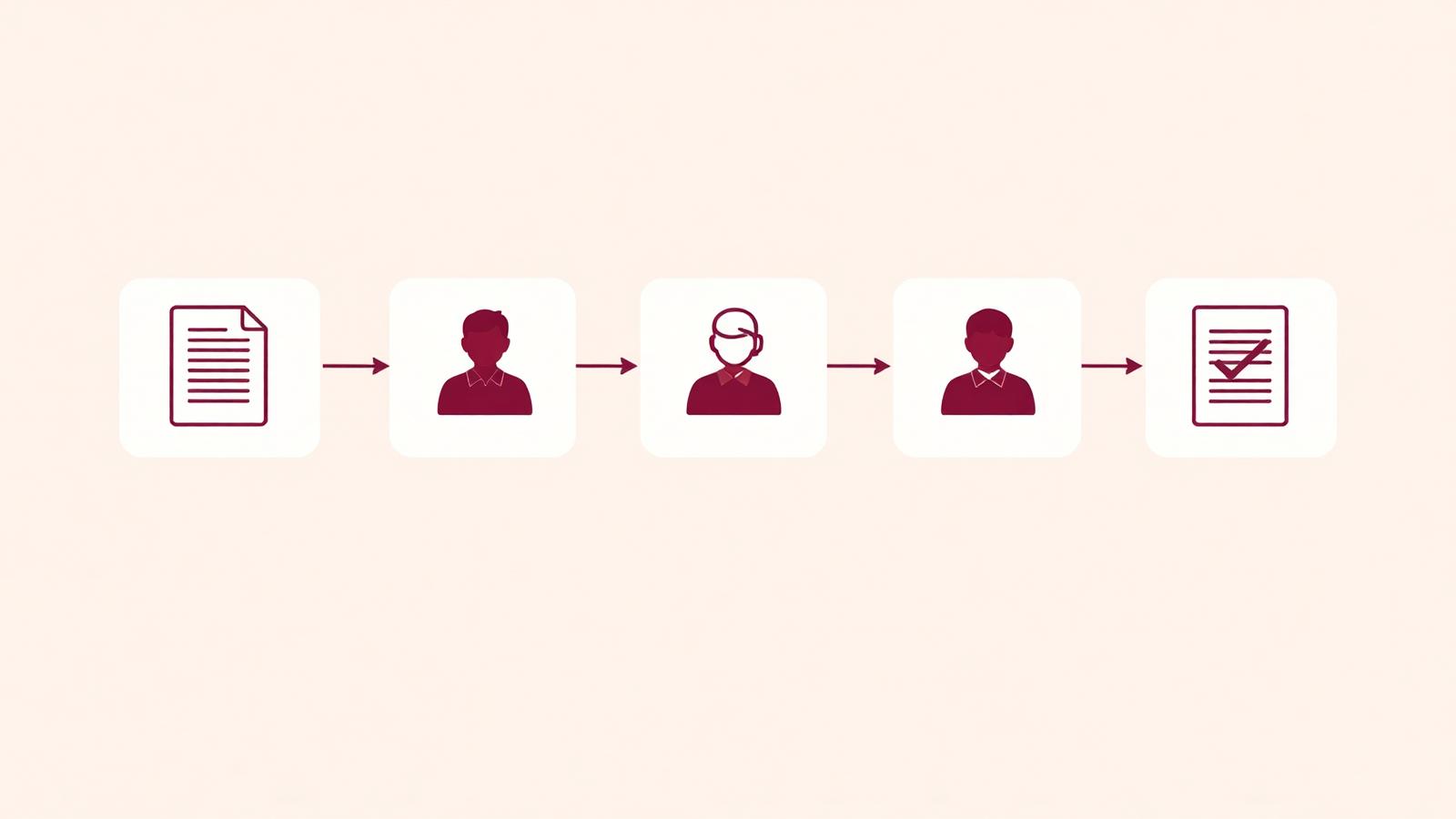
Phase two: complex single-function workflows
Once the first workflow is stable and the team is confident with the platform, phase two extends to more complex workflows within the same functional area. Higher-value purchase approvals with more sophisticated routing. Multi-step approvals with different reviewer combinations at different stages. Approvals with more complex documentation requirements.
Phase two typically takes several months and produces the deeper capabilities that will support cross-functional expansion later. The team learns to configure routing rules, design forms that capture the right information, handle exceptions gracefully, and produce reports that finance and audit find useful.
By the end of phase two, the platform is properly established as a serious operational tool rather than a pilot. The team has confidence, the audit trail is proven, and the case for expanding beyond the initial function becomes obvious.
Phase three: cross-functional integration
Phase three is where workflow automation stops being a functional improvement and starts being a cross-functional operating discipline. Workflows that span multiple departments — a procurement approval that involves finance, operations, and legal; a hiring approval that involves HR, finance, and the hiring manager's department — become the target.
This phase requires more organisational sophistication than the earlier phases. Departments that had operated in parallel need to align on shared workflow definitions. Data models need to reconcile across functional boundaries. Governance structures need to accommodate cross-functional ownership.
The payoff is significant. Cross-functional workflows that used to consume weeks of cycle time and require constant chasing complete in days with minimal intervention. The business as a whole becomes faster and more coordinated. The cultural shift toward digital-first operations becomes visible externally as well as internally.

Ownership as the underrated success factor
The single most common cause of workflow automation failure is unclear ownership. When no one specifically owns a workflow — its configuration, its performance metrics, its ongoing improvement — the workflow drifts. Configuration decisions that were made carefully at launch get eroded by ad-hoc adjustments. Performance metrics stop being reviewed. The workflow becomes another system that exists but does not improve.
Every workflow needs a named operational owner. This person is responsible for the ongoing configuration of the workflow, for the metrics that measure its performance, and for the iterative improvements that keep it aligned with the business. They are often not the person who originally implemented the workflow — they are the person who lives with it operationally.
Businesses that establish clear ownership from the outset produce workflows that improve over time. Businesses that treat implementation as ownership produce workflows that decay after launch.
Change management is the harder half
The technology decisions in workflow automation are usually not the hardest part. The change management decisions are. Employees who are used to approving via email need to learn a new pattern. Managers who used to have informal discretion need to accept that certain routing rules are now enforced. Executives who used to approve casually need to engage with structured requests.
Well-planned change management addresses this explicitly. Training that focuses on why the change matters, not just how the new system works. Communication that acknowledges the transition costs and commits to supporting people through them. Feedback mechanisms that allow people to raise issues and see them addressed.
Businesses that invest properly in change management produce workflows that are actually used. Businesses that skip this investment produce workflows that people work around, quietly returning to email approvals whenever the new system is inconvenient.
The two-year timeline that is realistic
A realistic timeline for meaningful workflow automation across a mid-sized business is two years. Phase one — the first workflow — typically takes six to twelve weeks including proper change management. Phase two — several more workflows in the same function — takes another six to twelve months. Phase three — cross-functional workflows — takes another year to mature.
Executives who expect to modernise everything in six months are almost always disappointed. The technology can move that fast; the organisational adoption cannot. Compressing the timeline produces workflows that were technically deployed but not operationally adopted, which is the same as not being deployed.
Businesses that commit to the two-year horizon and execute it patiently emerge with genuinely different operations. Businesses that rush the timeline emerge with a partially deployed platform and a team that has learned to distrust workflow automation. The sequencing discipline is not optional; it is what determines the outcome.
References & further reading
Authoritative research and industry sources that informed this article.
- [1]Reimagining the Corporate Function
McKinsey & Company
- [2]The Case for Digital Reinvention
Harvard Business Review
- [3]
- [4]
- [5]eIDAS Regulation on Electronic Signatures
European Commission
Frequently asked
What if leadership wants faster results?
Show them phase one results — those come within a quarter. Use the credibility to secure the longer horizon for the full program.
Can we run multiple phases in parallel?
Modestly, once phase one is stable. Trying to run three phases simultaneously from a standing start usually stalls all three.
Who should own the overall program?
A senior operations leader with authority across the functional areas involved. Not IT, not a project manager — a business owner.
How do we know when to move from one phase to the next?
When the current phase's workflows are stable, adopted, and delivering the expected metrics without ongoing intervention. Stability is the trigger, not calendar time.
Related articles in Approval Management
Digital Approval Workflows: The Quiet Productivity Revolution
Approvals are one of the most consistently underestimated sources of organisational drag. Getting them right is one of the highest-return, lowest-glamour operational upgrades available.
12 min readApproval ManagementHR Approval Systems: Time-Off, Hiring, and Everything Between
HR is one of the approval-heavy functions in most businesses. Modernising its workflows removes a category of frustration for employees and managers alike, and produces cleaner data along the way.
11 min readApproval ManagementProcurement Approval Automation: From Requisition to Purchase Order
Procurement is one of the most approval-heavy functions in enterprise operations and one of the most rewarding to modernise. This is what a well-designed procurement approval workflow looks like.
12 min read