
HR Approval Systems: Time-Off, Hiring, and Everything Between
HR is one of the approval-heavy functions in most businesses. Modernising its workflows removes a category of frustration for employees and managers alike, and produces cleaner data along the way.
By HololTeck Editorial

Key takeaways
- 01HR runs on approvals — time-off, hiring, promotions, expenses, benefits changes, and dozens of others.
- 02Modern HR approval workflows integrate with HRIS and payroll to eliminate double entry.
- 03Self-service portals reduce HR administrative load significantly.
- 04The employee experience of HR is disproportionately shaped by approval workflow quality.
- 05Compliance requirements shape but do not restrict what is possible with digital HR approvals.
The scope of HR approvals in a typical business
HR is one of the most approval-intensive functions in most businesses, and the volume tends to be under-appreciated. Time-off requests alone can account for hundreds of approvals per week in mid-sized organisations. Hiring approvals — requisitions, offers, salary adjustments — add another layer. Benefits changes, promotions, transfers, training authorisations, expense reimbursements for HR-adjacent activities, and dozens of smaller categories round out the picture.
In many businesses, the HR team spends a substantial portion of their time simply routing, chasing, and processing approvals. This is time that could be spent on higher-value work — talent development, employee experience, workforce planning — if the approval mechanics were properly digitised.
Time-off management as the entry point
Time-off management is the most common entry point for HR approval digitisation, and for good reason. It is high volume, it is well understood, and the pain of doing it manually is universally recognised. Employees submit requests through a range of channels — email, chat, verbal conversations, sometimes formal forms. Managers approve inconsistently. HR ends up chasing both parties to reconcile records.
A well-designed digital time-off workflow eliminates most of this. Employees submit requests through a mobile-friendly interface that shows their available balance, checks for conflicts, and routes to the right manager. Managers see requests with team calendar context and approve in seconds. Approved time-off flows automatically to the HRIS and to payroll. The employee sees their updated balance immediately.
The productivity effect is significant, but the emotional effect is larger. Employees experience an HR function that respects their time. Managers stop feeling like the process bottleneck. HR stops chasing.
Hiring approvals: from requisition to offer
The hiring approval flow — requisition, budget approval, offer approval, onboarding kickoff — is one of the most consequential and one of the most commonly broken in modern businesses. Delays at any stage compound. A requisition that sits for two weeks is a candidate lost to competitors. An offer approval that takes three days is a candidate who signs elsewhere.
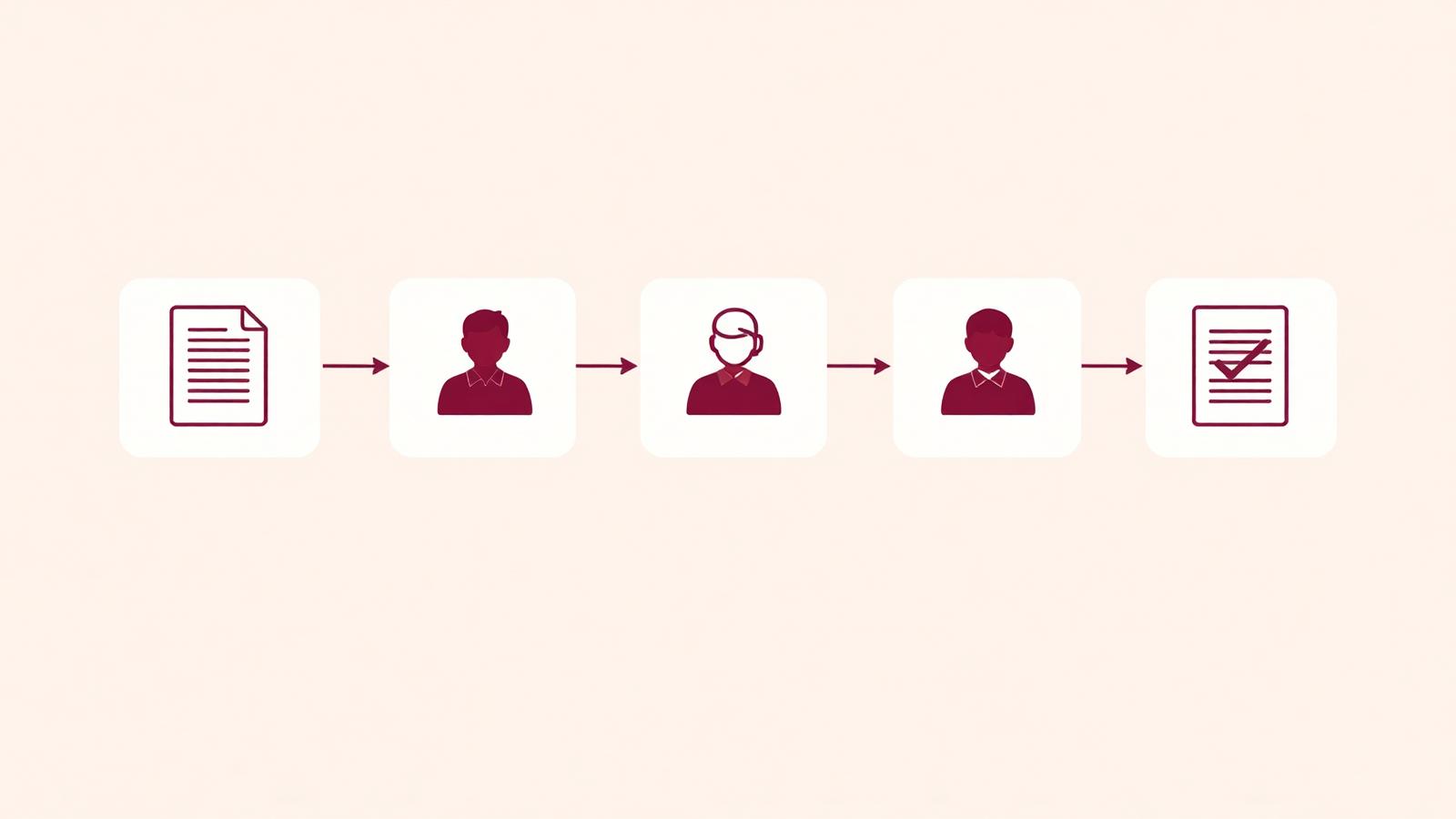
Digital workflows compress each stage. Requisitions include the structured information the approvers need. Budget approval happens in the finance system with the request context attached. Offer approvals route to hiring managers, HR business partners, and executives in parallel where appropriate rather than sequentially. Each party acts on their phone in minutes rather than at their desk in hours.
The competitive advantage from faster hiring is significant in tight talent markets. Businesses that hire in days rather than weeks close candidates that would otherwise disappear. This is one of the most measurable HR outcomes of digital approvals.
Self-service portals reduce HR load
A well-designed HR self-service portal handles a large share of employee requests without requiring HR involvement. Address changes. Direct deposit updates. Benefits enrolments and changes. Certificate requests. Training authorisations. Each of these can be handled through self-service with automated approval where appropriate and structured routing where human review is needed.
The load reduction on HR is significant. Time that used to go into administrative processing becomes available for higher-value work. And the employee experience improves because self-service is often faster than traditional HR ticket queues.
The design of the portal matters. A clean, mobile-friendly interface with clear categorisation and status tracking produces high adoption. A clunky legacy interface produces employees who continue emailing HR directly because self-service is worse than the alternative.

Integration with HRIS and payroll
The value of digital HR approvals compounds significantly when they integrate with the HRIS and payroll systems. Approved time-off automatically updates leave balances and payroll. Approved raises automatically update compensation records and next payroll runs. Approved new hires automatically create HRIS records and trigger onboarding workflows.
Without this integration, digital approvals are still valuable — but the downstream administrative work of updating records in multiple systems consumes much of the time saved. With proper integration, the workflow is truly end-to-end and the value is fully realised.
This is where platform choice matters. Approval platforms that integrate deeply with major HRIS systems produce dramatically better outcomes than platforms that require manual reconciliation. Evaluate integrations rigorously during selection.
Compliance and audit in HR approvals
HR approvals are often subject to regulatory and audit requirements. Records need to be retained for defined periods. Approval chains need to demonstrate appropriate segregation of duties. Discrimination-sensitive decisions need to be documented in ways that support review.
Digital workflows handle these requirements more reliably than manual processes. Every action is timestamped and attributed. Retention policies are enforced automatically. Approval chains are structured rather than ad hoc. When an audit or a legal review requires investigation of a specific decision, the answer is available in minutes rather than days.
This audit capability is one of the specific reasons regulated industries and larger enterprises tend to prioritise HR approval digitisation. But the benefit accrues to smaller businesses too, whenever a dispute arises and the audit trail is what settles it.
The employee experience impact
The employee experience of HR is disproportionately shaped by approval workflow quality. Employees who submit time-off requests and get approvals in minutes think differently about the HR function than employees whose requests sit for days. Employees who complete a hiring offer flow in a day think differently about the business than employees who wait a week for signatures.
This effect is measurable in engagement surveys and in retention. HR functions that have modernised their approval workflows consistently report improvements in employee-facing metrics that go well beyond what the technology investment might suggest.
This is the argument for HR to be an early adopter rather than a late one. The technology is available. The ROI is measurable. And the impact on the employee experience is one of the most consequential things HR can deliver.
References & further reading
Authoritative research and industry sources that informed this article.
- [1]Reimagining the Corporate Function
McKinsey & Company
- [2]The Case for Digital Reinvention
Harvard Business Review
- [3]
- [4]
- [5]eIDAS Regulation on Electronic Signatures
European Commission
Frequently asked
Where should HR start with digital approvals?
Time-off management is almost always the right starting point. High volume, well understood, universally welcomed by employees.
Can we integrate with our existing HRIS?
Modern approval platforms integrate with major HRIS systems. Custom integrations for less common systems are usually possible.
What about approvals that involve sensitive personal information?
Digital workflows can handle sensitivity through access controls, encryption, and audit trails. Compliance requirements shape the design; they do not prevent it.
How do we handle exceptions and unusual cases?
Digital workflows escalate exceptions to human review rather than trying to automate everything. The design should make escalation easy and preserve context.
Related articles in Approval Management
Digital Approval Workflows: The Quiet Productivity Revolution
Approvals are one of the most consistently underestimated sources of organisational drag. Getting them right is one of the highest-return, lowest-glamour operational upgrades available.
12 min readApproval ManagementProcurement Approval Automation: From Requisition to Purchase Order
Procurement is one of the most approval-heavy functions in enterprise operations and one of the most rewarding to modernise. This is what a well-designed procurement approval workflow looks like.
12 min readApproval ManagementInvoice Approval Automation: The Accounts Payable Modernisation Story
Accounts payable is often the last function to be modernised. This is what a modern AP workflow looks like and why it belongs on the roadmap of any operations leader who cares about cash flow.
11 min read