
Digital Approval Workflows: The Quiet Productivity Revolution
Approvals are one of the most consistently underestimated sources of organisational drag. Getting them right is one of the highest-return, lowest-glamour operational upgrades available.
By HololTeck Editorial

Key takeaways
- 01Approval workflows are often the largest source of hidden delay in business operations.
- 02The right digital workflow is faster, more auditable, and cheaper than manual approval routing.
- 03Automation should handle routing and reminders; humans should retain judgement on outcomes.
- 04The right implementation typically pays back in months, not years.
- 05Executive time savings alone often justify the entire investment.
The hidden cost of manual approvals
Every business runs on approvals. Expense claims. Purchase orders. Time-off requests. Contract sign-offs. Marketing spend. New hires. Discount authorisations. In a typical mid-sized business, hundreds or thousands of approvals move through inboxes each week. Each one requires the requester to send a request, the approver to review it, and often several intermediate parties to add their sign-off before the process completes.
The full cost of this is enormous and largely invisible. The approver time is obvious. The requester time waiting is less obvious. The compounding delay when approvals sit unattended, when the wrong person is emailed, when documents get lost in threads, when approvals need to be re-requested because the original context has been lost — all of this is a tax the business pays every day without ever tallying the bill.
The businesses that have digitised their approval workflows properly consistently describe the productivity effect as one of the largest and most underestimated wins they have seen from operational technology.
What a modern digital approval workflow looks like
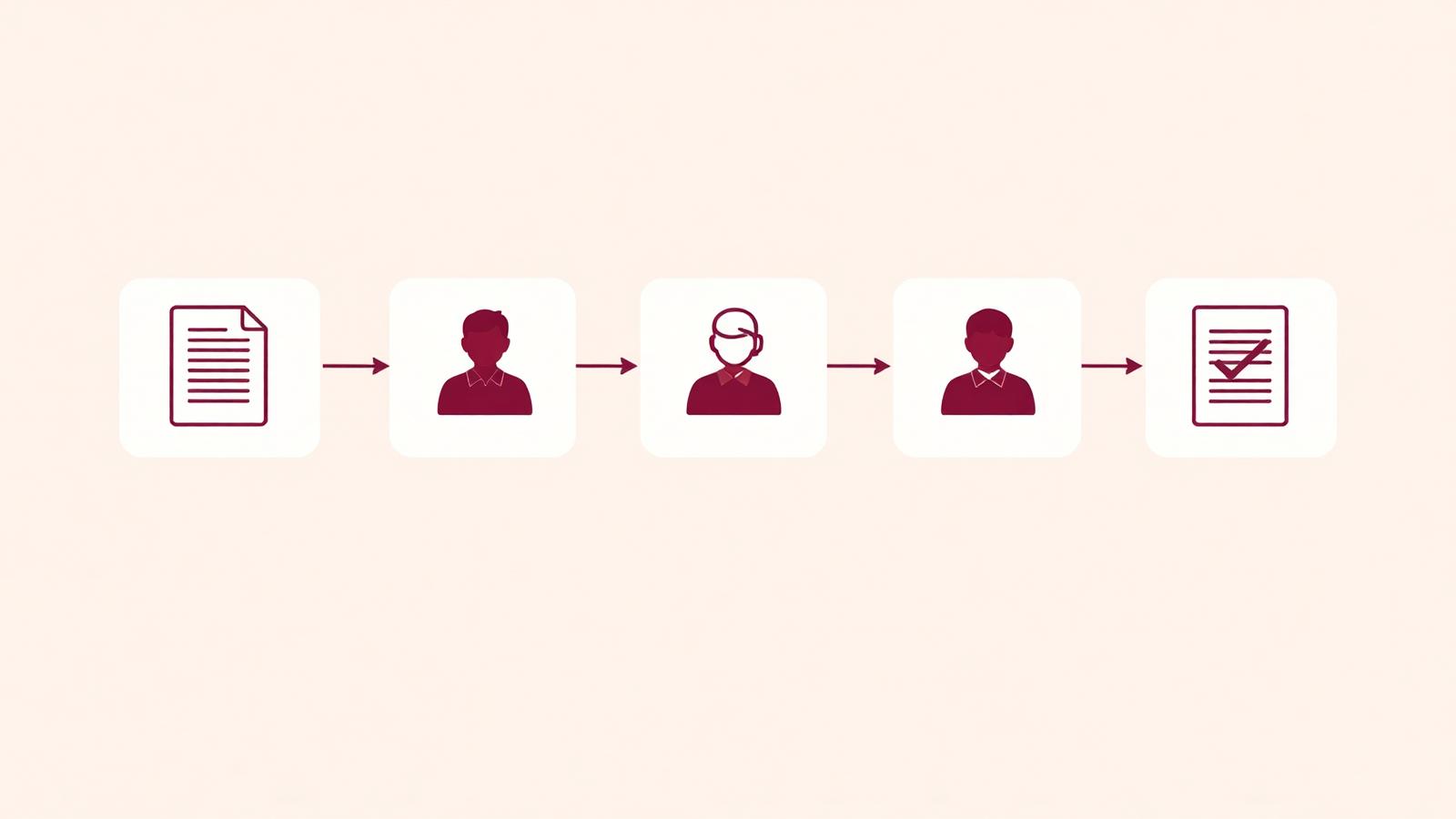
A modern digital approval workflow starts with a structured request form that captures everything the approver will need to decide. It routes automatically to the right approver based on the type of request, the amount, the department, and any other relevant criteria. It notifies the approver on the channel they actually use — often WhatsApp or a mobile-optimised interface — with the context inline rather than as an attachment they have to open.
The approver can act on the request with a single tap: approve, reject, or request more information. If the approval involves multiple parties, the workflow moves to the next automatically. Timeouts trigger reminders. Escalations happen without human intervention. Every action produces a complete audit trail.
From the requester's perspective, they submit and then get notified of the outcome. From the approver's perspective, they get clear requests with everything they need to decide, and they can act quickly regardless of where they are. The friction that used to consume everyone's time simply disappears.
Routing logic that reflects how the business actually works
The heart of a good approval workflow is the routing logic. Simple businesses might have simple rules: expenses under a threshold go to the direct manager; above the threshold, to the department head; above another threshold, to finance. More complex businesses have more elaborate rules: purchases in specific categories go to specialist approvers; requests from specific business units follow specific paths; certain approvers have delegated authority under defined circumstances.
The routing logic should reflect how the business actually operates, not how it is described in the org chart. This means talking to the people who actually approve things and understanding the nuances of their workflow. It also means designing the rules in a maintainable way, so that when a role changes, or a threshold updates, or a business unit reorganises, the rules can be updated without a project.
Serious approval platforms make this configurable through visual workflow designers rather than requiring code changes for every adjustment. This is what allows the workflow to keep pace with the business.
Approval on the go: mobile as a first-class citizen
Executives approve on their phones. Managers approve between meetings. Field staff approve from the site. Any approval workflow that assumes the approver is at a desk with a full computer screen misses most of when approvals actually happen.
Mobile-first design is not a nice-to-have; it is the primary interface for most approvers. The request needs to display cleanly on a small screen with all the essential context visible without scrolling. The action needs to be a single tap. The confirmation needs to be immediate.
WhatsApp-based approvals take this to its logical conclusion, delivering approval requests directly into the messaging thread the approver already uses. This has been transformative in businesses where executives are constantly on the move. The friction of switching apps disappears; approvals happen while walking between meetings.

The audit trail nobody thinks about until they need it
One of the underappreciated benefits of digital approval workflows is the complete audit trail they produce. Every request. Every action. Every timestamp. Every comment. All searchable, all retrievable, all defensible in front of an auditor or a regulator.
Compared to the alternative — approvals happening in email threads, chat messages, and verbal conversations — this is a step change in accountability. When a question arises about who approved what, when, and why, the answer is one query away rather than a week of forensic email archaeology.
In regulated industries, this audit capability alone often justifies the investment. In unregulated industries, it becomes valuable the first time a dispute arises where the audit trail is what settles it.
Automation with human judgement preserved
The right division of labour in approval workflows is that automation handles routing, reminders, timeouts, and audit — and humans retain judgement on outcomes. The system delivers the request to the right person with the right context; the person decides.
This division is important. Fully automated approvals — where the system decides whether to approve based on pre-defined rules — can work for low-stakes, high-volume categories, but they carry risk. Rules always miss edge cases. Edge cases add up. Fully automated approvals should be reserved for the categories where the rules are well-understood and the downside of a wrong decision is bounded.
For everything else, the system supports human judgement rather than replacing it. This is where trust in the workflow gets built and where the productivity gains are real without the risk of the wrong outcomes at scale.
The ROI is faster than most executives expect
The ROI on digital approval workflows is faster than most executives expect. Time savings for approvers are immediate. Reduction in approval cycle times shows up in weeks. Improvement in downstream processes — faster payments, faster hires, faster procurement — appears within a quarter.
In deployments we have observed, the fully loaded cost of the previous approval process — approver time, requester waiting, cycle time impact on downstream work — was several multiples of the cost of the digital workflow that replaced it. Payback periods measured in months rather than years are the norm.
This is one of the areas where the operational discipline of measuring baseline costs before implementation pays disproportionate dividends. When the after-state numbers are compared against a well-established baseline, the ROI is undeniable and the case for expanding to additional approval categories makes itself.
References & further reading
Authoritative research and industry sources that informed this article.
- [1]Reimagining the Corporate Function
McKinsey & Company
- [2]The Case for Digital Reinvention
Harvard Business Review
- [3]
- [4]
- [5]eIDAS Regulation on Electronic Signatures
European Commission
Frequently asked
Where should we start with digital approval workflows?
Usually with the highest-volume, lowest-stakes category — expense claims or purchase requisitions are common entry points. Success there builds credibility for higher-stakes categories.
Can the same platform handle all our approval types?
Yes. Modern approval platforms are designed to handle multiple workflow types with different routing rules and forms. Consolidation on a single platform is usually preferable to multiple point solutions.
What about approvals that require complex documentation?
Modern workflows attach documents inline and preserve them in the audit trail. Version control and access controls are handled natively.
How do we handle approvers who are on leave?
Delegation rules can be configured for planned absences, and timeouts with automatic escalation handle unplanned absences.
Related articles in Approval Management
HR Approval Systems: Time-Off, Hiring, and Everything Between
HR is one of the approval-heavy functions in most businesses. Modernising its workflows removes a category of frustration for employees and managers alike, and produces cleaner data along the way.
11 min readApproval ManagementProcurement Approval Automation: From Requisition to Purchase Order
Procurement is one of the most approval-heavy functions in enterprise operations and one of the most rewarding to modernise. This is what a well-designed procurement approval workflow looks like.
12 min readApproval ManagementInvoice Approval Automation: The Accounts Payable Modernisation Story
Accounts payable is often the last function to be modernised. This is what a modern AP workflow looks like and why it belongs on the roadmap of any operations leader who cares about cash flow.
11 min read