
Compliance and Audit Trails: What Digital Approvals Deliver That Manual Cannot
Regulators, auditors, and increasingly customers expect businesses to demonstrate that their decisions were made properly. Digital approval workflows produce this evidence as a by-product of normal operations.
By HololTeck Editorial

Key takeaways
- 01Digital approval workflows produce audit trails that manual processes cannot match at any reasonable cost.
- 02Regulatory expectations increasingly assume digital evidence rather than reconstructed narratives.
- 03Segregation of duties is dramatically easier to demonstrate in digital workflows.
- 04Data retention and disposal can be enforced automatically rather than left to individual discipline.
- 05The compliance benefit alone often justifies workflow modernisation in regulated industries.
The rising bar for compliance evidence
The bar for compliance evidence has risen steadily over the past decade. Regulators expect businesses to demonstrate not just that they made appropriate decisions but that they made them through appropriate processes. Auditors expect complete, retrievable audit trails rather than reconstructed narratives. Enterprise customers expect their suppliers to demonstrate the same discipline they themselves are held to.
Manual processes struggle to meet this bar at any reasonable cost. Email chains as approval records. Verbal approvals with no documentation. Approvals from people who lacked the appropriate authority but whose lack of authority was not obvious at the time. Each of these creates compliance risk that becomes visible only when a specific decision comes under review.
Digital workflows produce compliance evidence as a by-product of normal operations. Every action is timestamped, attributed, and preserved. The evidence is available when needed without requiring investigation.
What a comprehensive audit trail looks like
A comprehensive audit trail for an approval workflow captures: the request submission with the requester's identity and the complete request content, the routing decisions that determined which approvers received the request and why, each approver's action and the exact time of the action, any comments or additional information provided during approval, any escalations or timeouts that triggered alternative routing, and the final outcome with the effective date and any downstream consequences.
All of this is captured automatically as part of the normal workflow. There is no additional work required from the operators. The evidence is complete because the system cannot function without capturing it.
Compare this to the manual alternative: reconstructing the same information from email archives, calendar records, and human memory, weeks or months after the fact, usually under time pressure from an audit request. The manual approach is expensive, imperfect, and increasingly unacceptable to serious reviewers.
Segregation of duties made concrete
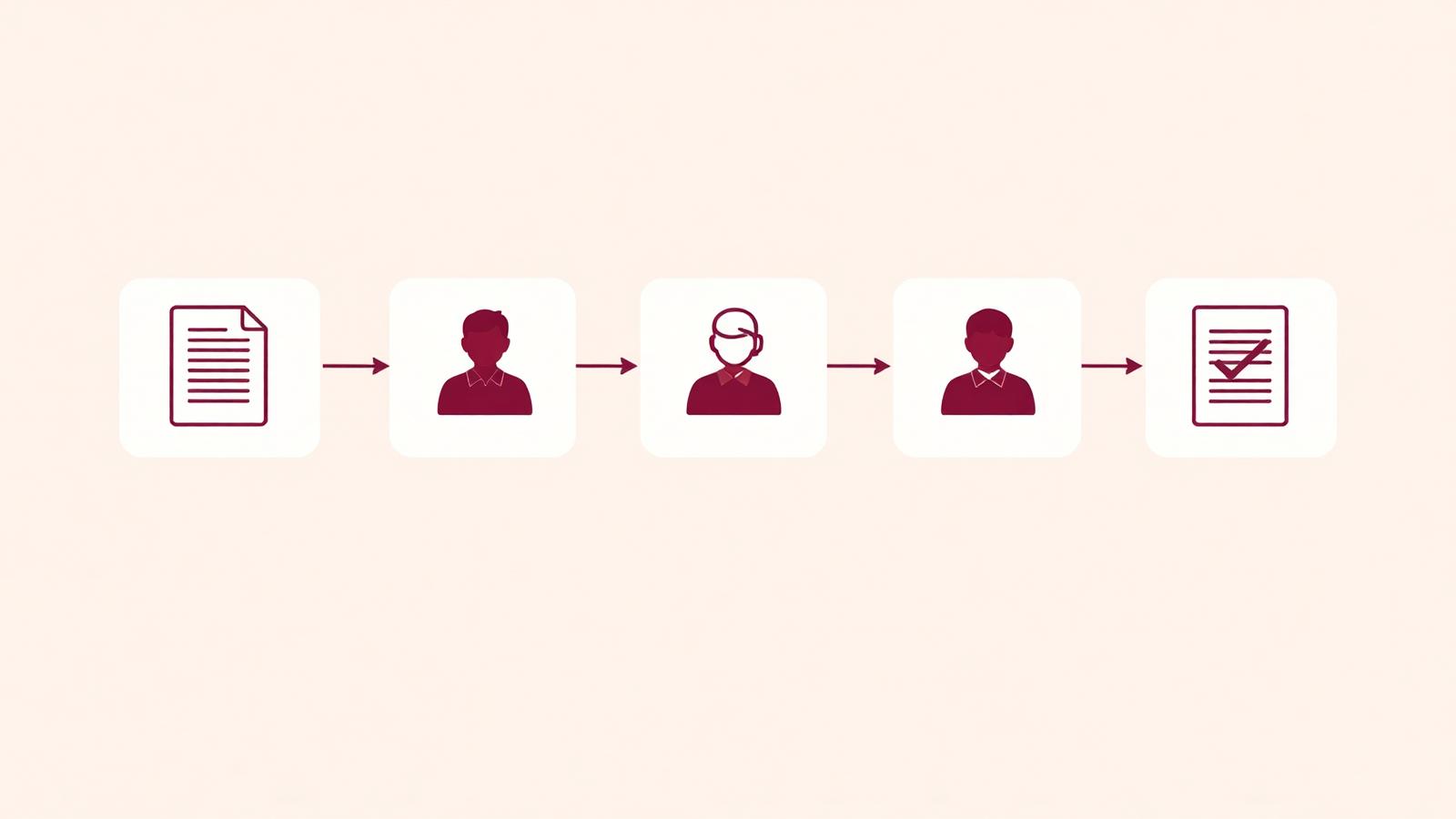
Segregation of duties — the principle that no single person should have unchecked authority over a consequential transaction — is a cornerstone of financial control and a common audit finding when it is not properly implemented. Manual processes make this difficult to enforce and even more difficult to demonstrate.
Digital workflows enforce segregation of duties by design. The same person cannot both submit and approve a request. Approvers must be genuinely different individuals from requesters. Sequential approvals through multiple parties are enforceable rather than aspirational.
This makes compliance with segregation requirements a design outcome rather than an operational discipline. The system prevents violations rather than relying on individual awareness to avoid them.
Data retention and disposal
Regulatory frameworks increasingly specify not just what data must be retained but for how long and how it must be disposed of at the end of the retention period. Manual approach to this — hoping individuals delete emails and documents at the right time — is unrealistic at scale and produces compliance risk.
Digital workflows enforce retention policies automatically. Records are preserved for the required period. Disposal happens at the appropriate time. The evidence that both were done correctly is itself part of the audit trail.
This automation is particularly valuable in jurisdictions with strict data protection requirements. GDPR, similar frameworks in other jurisdictions, and industry-specific requirements all become easier to comply with when the workflow enforces the policy rather than leaving it to individual discipline.

Investigation and response
When a question arises about a specific decision — from a regulator, an auditor, a customer, or an internal review — the ability to respond quickly and completely matters enormously. Businesses that can produce full documentation within hours build trust. Businesses that need weeks to reconstruct the record raise concerns even when the underlying decision was correct.
Digital audit trails support fast, complete response. The specific request in question can be located in minutes. The full context — who approved, when, based on what information — can be assembled instantly. The response to the reviewer is definitive rather than tentative.
This capability is one of the specific reasons regulated industries prioritise workflow modernisation. The cost of a slow, incomplete response to a regulatory inquiry can be significant. The cost of the technology that prevents this is modest by comparison.
Beyond compliance: the internal trust dividend
The compliance benefits of digital audit trails are the most obvious, but the internal benefits are often just as significant. When employees know their actions are documented and reviewable, they act with more care. When managers can trace how decisions were actually made, they can improve the decision process. When leadership can see the operational patterns of the business through the audit trail, they can identify improvements that would be invisible in aggregate metrics.
This internal transparency is a soft benefit that compounds. Businesses that operate with clear audit trails tend to develop cultures of accountability that manual processes cannot support. Decisions get made more thoughtfully. Delegations are honoured more consistently. Rogue actions are caught earlier.
None of this is guaranteed by technology alone. But the technology creates the conditions under which the cultural improvements become possible.
Choosing compliance-ready platforms
Not all approval platforms are equally compliance-ready. The features that matter are: comprehensive audit trail capture as a non-negotiable default, tamper-evident storage of audit records, configurable retention policies with automatic enforcement, segregation-of-duties enforcement in workflow design, and role-based access control with attribution.
During platform selection, these should be evaluated rigorously rather than accepted on the vendor's assurance. Ask for demonstrations. Review the audit trail format. Understand the retention configuration. Verify the tamper-evidence claims.
In regulated industries, the platform's compliance readiness should often be a threshold criterion rather than a comparison point. A platform that fails on any of these criteria should be excluded, regardless of its other features. The compliance stakes are too high to compromise on the fundamentals.
References & further reading
Authoritative research and industry sources that informed this article.
- [1]Reimagining the Corporate Function
McKinsey & Company
- [2]The Case for Digital Reinvention
Harvard Business Review
- [3]
- [4]
- [5]eIDAS Regulation on Electronic Signatures
European Commission
Frequently asked
How long should we retain approval records?
Per your applicable regulatory and industry requirements. Digital workflows can enforce these automatically once they are configured.
Are digital signatures legally equivalent to physical signatures?
In most jurisdictions, yes, when captured through compliant workflows. Verify specifics for your jurisdiction and industry.
What happens if an audit trail is accidentally deleted?
Well-designed platforms make deletion effectively impossible through operational error and require specific administrative actions with their own audit trail for retention policy execution.
How do we handle audit requests for the pre-digital period?
The manual records remain what they were. The digital workflow improves everything going forward without changing the historical baseline.
Related articles in Approval Management
Digital Approval Workflows: The Quiet Productivity Revolution
Approvals are one of the most consistently underestimated sources of organisational drag. Getting them right is one of the highest-return, lowest-glamour operational upgrades available.
12 min readApproval ManagementHR Approval Systems: Time-Off, Hiring, and Everything Between
HR is one of the approval-heavy functions in most businesses. Modernising its workflows removes a category of frustration for employees and managers alike, and produces cleaner data along the way.
11 min readApproval ManagementProcurement Approval Automation: From Requisition to Purchase Order
Procurement is one of the most approval-heavy functions in enterprise operations and one of the most rewarding to modernise. This is what a well-designed procurement approval workflow looks like.
12 min read